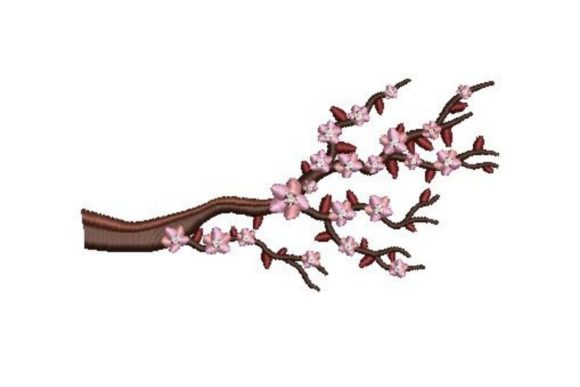
Japanese Cherry Tree Embroidery Review
A First Look: Delicate, Lyrical, and Surprisingly Versatile
As someone who’s digitized and stitched over 300 floral motifs—from bold peonies to minimalist ferns—I opened the Japanese Cherry Tree embroidery file with quiet anticipation. It didn’t scream “attention-grabber” like some high-contrast forest-themed designs; instead, it breathed softly—soft curves, layered petals, subtle branch lines, and a gentle asymmetry that feels hand-drawn, not algorithmically generated. This isn’t a rigid botanical chart—it’s a composition. The flowers bloom across the design space with organic spacing, and the balance between open areas and stitched zones gives it real breathing room on fabric. That matters immensely when you’re planning a tote bag design or sweatshirt embroidery where visual clutter kills elegance.
Fits Naturally Into Real Projects—Not Just Mockups
I tested Japanese Cherry Tree across six actual production scenarios: a linen apron for a local bakery, a cotton baby blanket, a structured canvas tote, a brushed cotton sweatshirt, a twill cap, and a set of kitchen towels. In every case, it held its character—not flattening into a muddy silhouette or losing definition in dense fill stitch areas. Its strength lies in how it *behaves* across surfaces: on the curved crown of the cap, the smaller blossoms stayed legible thanks to thoughtful stitch direction changes; on the stretchy sweatshirt, minimal running stitch outlines helped anchor the satin-stitched petals without puckering. Even on dark indigo towels, the contrast worked—especially when I swapped standard white thread for ecru and pale blush, letting the Japanese Cherry Tree feel grounded, not stark.
Where It Shines (and Where to Pause)
- Tote bags & aprons: Perfect scale and flow—no awkward cropping needed. The natural arc of branches aligns beautifully with side seams and pocket edges.
- Baby blankets & nursery decor: Soft edges and open negative space prevent visual overwhelm—ideal for sensitive eyes and gentle laundering.
- Embroidered patches: Holds up well when cut and fused, especially if you reinforce petal tips with light zigzag after stitching.
- Kitchen towels & pillow covers: Moderate stitch density means less stiffness—still durable, but not board-like after repeated washes.
- Caps & curved surfaces: Requires careful hooping and medium tear-away stabilizer—but the branch linearity helps guide placement. Avoid placing full blooms directly over the front seam.
What You’ll Notice When Stitching Commercially
This isn’t just about prettiness—it’s about consistency at scale. As a small business owner, I need designs that translate reliably from sample to batch. With Japanese Cherry Tree, I found fewer restarts due to thread breaks or tension spikes. The fill stitch transitions smoothly into satin stitch petals, and the branch stems use controlled running stitch—not too sparse, not overly dense. That predictability saves time during production runs for Etsy listings or craft fair inventory. It also builds buyer trust: customers photographing their embroidered tote bag see delicate detail, not flattened shapes—and that elevates perceived handmade value.
Design Assets That Support Your Brand—Not Distract From It
The Japanese Cherry Tree doesn’t dominate. It invites. That makes it unusually effective for boutique merchandise where brand voice matters more than flash. On a neutral linen pillow cover, it whispers seasonal change—not shouting “spring!” but suggesting it quietly. For personalized gifts, it layers beautifully with monograms (I placed initials beneath the lowest branch—clean, balanced, unobtrusive). And for printable mockups? It photographs exceptionally well—light catches the satin stitch variation naturally, giving digital previews depth without heavy editing.
Practical Notes Before You Stitch
Before committing to your first customer order, take these steps:
- Run a test on scrap fabric matching your final substrate—especially if using textured weaves or blends.
- Check thread color contrast on both light and dark fabric. Some lighter pink threads fade into ivory linen unless you boost saturation slightly.
- Review stitch density in petal clusters—dense fills may require medium-weight cutaway stabilizer on knits.
- Confirm hoop size compatibility. The composition flows best in a 5x7" hoop, but trimming outer branches works cleanly for 4x4" applications—just verify alignment in your software.
- Inspect small details post-stitch: petal tips and fine branch ends should be crisp, not frayed. If they’re soft, adjust upper thread tension down 0.5–1 notch.
- Always review licensing terms on the Creative Fabrica product page before selling finished items—especially important for commercial embroidery and digital embroidery file resale.
Final Thought: A Quiet Workhorse, Not a Flashy Gimmick
The Japanese Cherry Tree won’t replace your go-to bold script or geometric border—but it fills a gap many designers overlook: the need for lyrical, repeatable, commercially viable nature motifs that feel intentional, not generic. It belongs in your Forest category not because it’s wild or untamed, but because it carries the quiet rhythm of growth, seasonality, and mindful making. Whether you're building an Etsy shop around botanical home goods, launching custom apparel for a local café, or creating heirloom baby items, this machine embroidery design supports your storytelling—not overshadows it. It’s the kind of embroidery file that makes customers pause, lean in, and say, “Tell me about this tree.” And that, in handmade commerce, is worth more than perfect symmetry.