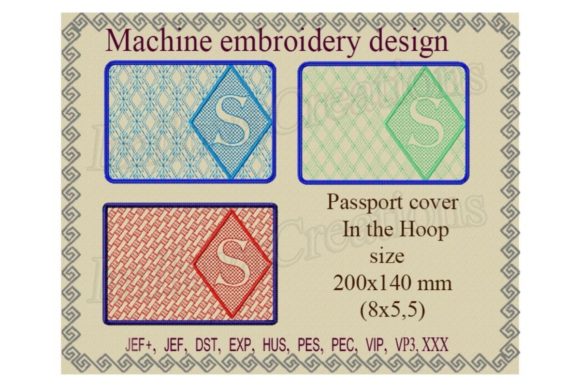
A Business Review of the In the Hoop Passport Cover - S
As an embroidery designer who works extensively with small businesses, I'm constantly evaluating new machine embroidery designs for their potential beyond personal crafting. When a design like the In the Hoop Passport Cover - S comes across my screen, my first question isn't just "is it pretty?" but "can it build a brand?" This review focuses on that exact perspective: how this embroidery file functions as a tool for branded merchandise, uniforms, and product enhancement.
First Impression: Sweet, Personal, and Surprisingly Versatile
The product description frames this as a sweet, cheerful design for personalizing a passport with an initial. That immediately gives it a friendly, handmade, and slightly classic feel. It doesn't scream "corporate logo," which is actually a strength for many modern small businesses. Cafés, boutique florists, pet brands, creative studios—these businesses thrive on a personal touch. The promise of multiple sizes is the critical detail here. For commercial embroidery, scalability is non-negotiable. A design that only works at one large hoop size is often useless for items like cap fronts or small product labels. The mention of multiple sizes suggests this design has been thought through for adaptation, a key point for business use.
Practical Business Applications Beyond the Passport
Let's move past the passport cover idea entirely. The true value for a small business lies in repurposing this design's structure and aesthetic.
As a Branded Patch or Product Accent
The circular or centered layout typical of an initial-based design makes the In the Hoop Passport Cover - S a prime candidate for an embroidered patch. Patches are incredibly versatile merch: they can be applied to tote bags, aprons, backpacks, or sold as standalone collectibles. For a bakery or café, a patch with the business owner's initial or a stylized letter could be a subtle, elegant mark on staff aprons. For an Etsy seller specializing in handmade goods, a small patch on the product packaging adds immense perceived value and a handmade presentation.
For Uniforms and Apparel Branding
This design could serve as a beautiful chest logo accent or sleeve detail on staff polos or work shirts. Its "cheerful touch" described in the product description translates to a warm, approachable brand identity. It feels less intimidating than a bold, blocky logo, which can foster customer trust and engagement for service-oriented businesses. For a small boutique, embroidering this on the front of a simple tote bag creates instant, premium-looking merchandise.
As a Cap or Hat Design
Cap embroidery requires designs that are dense enough to be clear but not so intricate that they vanish on a curved surface. The initial focus of the In the Hoop Passport Cover - S is promising. A single, well-rendered letter with decorative elements can be highly effective on a cap front, especially for businesses like gardening centers, pet stores, or outdoor cafes where caps are common staff attire or sellable merch.
Critical Considerations for Professional Use
While the potential is clear, deploying this design for commercial embroidery projects requires a professional's careful eye. Here are the areas to scrutinize before running a production order.
Scale and Detail Integrity
The product mentions multiple sizes, but the designer must test it at the intended small patch size. Does the initial remain clear and legible? Do any decorative surrounding elements become a muddy blob of stitches? High stitch density in a small area can lead to stiffness and fabric puckering, especially on curved surfaces like caps. Always create a printable mockup and test sew on the actual fabric—a denim apron, a cotton cap, a polyester polo—before committing.
Thread Color and Contrast
A "sweet" design often implies lighter thread colors. On dark uniforms—navy aprons, black polo shirts—this can be a disaster for visibility. My first step is always to test the design in black and white thread on both light and dark fabric scraps. This reveals the true contrast and readability, which is essential for brand recognition. Does the design rely on color shading to make sense? If so, it may not be robust enough for varied business apparel.
Fabric and Stabilizer Compatibility
The texture of the fabric dictates everything. Embroidering this design onto a thick canvas tote bag requires different stabilizer and potentially adjustments to stitch density compared to placing it on a fine cotton staff shirt. Frequent washing of uniforms is a reality; the design must be robust enough to withstand it without threads snapping or the embroidery distorting. Inspect the stitch spacing and outlines in the embroidery file for clean, secure paths.
Impact on Brand Identity and Professionalism
Choosing an embroidery design like this for your business merch is a brand statement. It leans towards elegance, personalization, and a crafted feel. It suggests attention to detail. For a customer, a tote bag with this kind of embroidered mark feels more premium than a screen-printed one. It elevates the product value. However, visual consistency is key. This design should compare well beside your other design assets—your website font, your main logo. If your brand is ultra-modern and minimalist, a "sweet" initial design might clash. For a rustic, friendly, or handmade brand, it could be perfect.
Final Designer Notes Before You Hoop It
To my fellow embroidery shops, apparel decorators, and merch creators: the In the Hoop Passport Cover - S is an intriguing template. Its value lies in its adaptability. Before using it for any client project or your own small business merchandise, follow this checklist:
- Confirm Commercial Licensing: The product description does not specify license terms. Never assume a personal-use embroidery file is okay for commercial embroidery. Verify this explicitly with the designer or distributor.
- Check Exact Hoop Size Availability: "Multiple sizes" is vague. Identify the specific hoop sizes the embroidery file comes in to ensure they match your project needs (e.g., 4x4 for caps, larger for tote bags).
- Run Practical Tests: Sew it out. Test it on the actual fabric, with the proper stabilizer, and at the production size. Look for puckering, thread breaks, and clarity.
- Client Approval via Mockup: For client work, always provide a digital mockup showing the design on the intended item—an apron, a cap, a patch on a bag. This avoids mismatch expectations.
In conclusion, the In the Hoop Passport Cover - S moves from a charming personal project to a legitimate business asset when viewed through the lens of scalability, application versatility, and brand alignment. For the right business—one built on personality, craftsmanship, and warm customer relationships—it could be the elegant, handmade touch that transforms simple merchandise into meaningful brand ambassadors.